
Vado e Vedo itineraries with GPS track
The Medici fountains scattered throughout the historic center of Pisa are the result of an ambitious urban and architectural renewal program initiated under Cosimo I de’ Medici. These public fountains celebrated the Grand Dukes who provided the city with a precious resource: fresh, clean water from the Monte Pisano.
The earliest fountains date back to the 16th and 17th centuries, followed by renovation works during the 18th and 19th centuries.
The route begins at the Fontana dei Putti in Piazza del Duomo, the most famous Medici fountain together with the Fontana del Gobbo in Piazza dei Cavalieri.
Step by step, crossing the Tramontana and Mezzogiorno districts, walkers are surprised by small details and subtle clues that reveal the oldest public fountains serving monasteries and popular squares. This walk is dedicated to discovering the symbols that silently tell the story of Medici Pisa, which became the second capital of the Grand Duchy of Tuscany.
Technical Sheet
- Walking time: approx. 2 hours
- Distance: 4.5 km
- Route type: loop
- Starting point: Fontana dei Putti (Piazza del Duomo)
- Map: download the route
- Connection to medium/long routes: Via degli Acquedotti (Piazza delle Gondole)
The Fountains You Will Encounter on This Urban Trek
Fontana dei Putti (A)
Piazza del Duomo required a water source to serve both residents and the many travelers visiting Pisa’s most important monumental area. Seventeenth-century documents from the Office of Rivers and Canals mention an earlier fountain known as “alle gradole,” located on the lawn but in a different position from today’s Fontana dei Putti.
Built in 1658 by master Marco Rondinosi, the original fountain was simple, made of brick and equipped with two water-spouting masks. It was dismantled and replaced by the Fontana dei Putti after 1763.
The current fountain, made of white marble, features a 17th-century base attributed to Giuseppe Vaccà and is decorated with mythological elements. Three winged putti support the emblem of the Opera del Duomo, designed by Giovan Battista Tempesti.

Fontana dell’Arcivescovado (B)
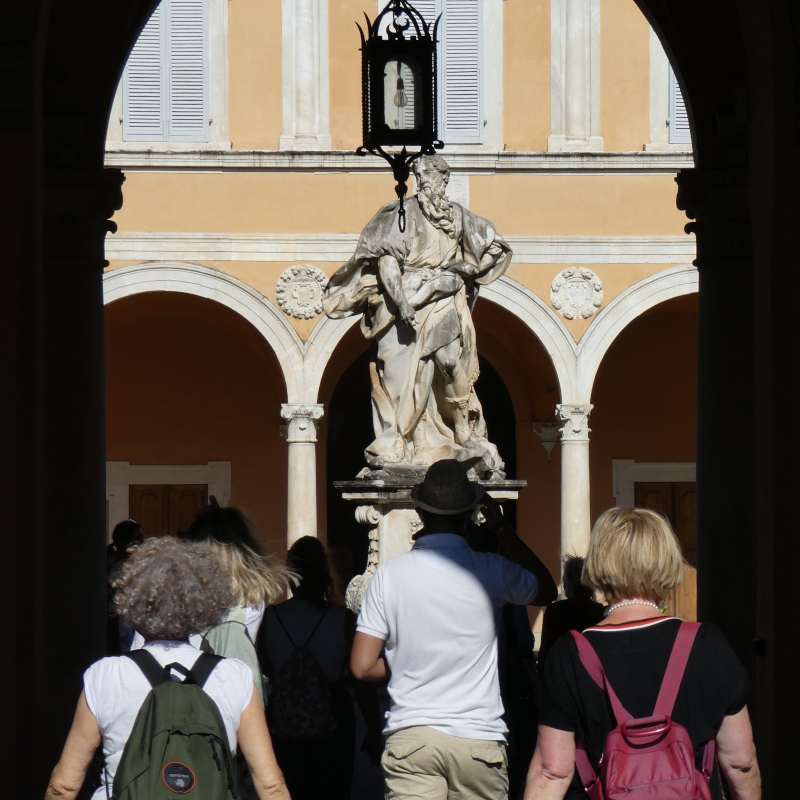
This richly decorated square-based fountain is topped by a statue of Moses sculpted by Andrea Vaccà in 1709. Water flowed from two masks into two basins, one shell-shaped and the other rectangular.
Fontana di Piazza Tongiorgi (C)
This small 18th-century fountain stands in a quiet square near the Church of San Giuseppe. Made of white San Giuliano marble, it consists of a base surmounted by a truncated pyramidal block from which water flows into a long, shallow basin.
Fontana di Piazza Martiri della Libertà (D)
Several religious complexes were connected to the water network, including the Church and Convent of Santa Caterina and the Monastery of San Lorenzo. The original fountain was destroyed along with the monastery.
The current neo-classical fountain was designed by Alessandro Gherardesca and features a fluted white marble column resting on a base with a projecting basin.
Fontana di Piazza d’Ancona (E)
Supplied by the Condotta della Religione, this fountain has a simple design with a sandstone column and white marble details, topped by a decorated sandstone spire. It stands near Palazzo Ruschi, once known as the second Piazza San Francesco.
Fontana di Via San Francesco (F)
The Convent of San Francesco was the first structure to request a water connection in 1627. The only surviving evidence is a deteriorated carved panel featuring a lion’s head. The fountain was later relocated and replaced in the mid-18th century to meet public water demand.
Fontana di Piazza delle Gondole (G)
This is the first urban fountain of the Medici Aqueduct. Entirely made of white San Giuliano marble, it has a classical aedicule shape with a shell-shaped niche and the Medici coat of arms. Water once flowed continuously, creating a refined water display while also serving public needs.
Fontana di Piazza San Luca (H)
Dating back to the 18th century, this simple fountain stands near the former Church of San Luca. It consists of a white marble column on a sandstone base, topped by a flattened pyramidal spire.
Fontana di Via San Martino (I)
This neo-classical marble fountain was built in the early 19th century by engineer Bombicci. It features a large fluted column set on an octagonal base and surrounded by sixteen smaller columns.
Fontana di Logge di Banchi (J)
The Logge di Banchi were built between 1603 and 1605 based on a design by Buontalenti. Beneath the Medici coat of arms dated 1605, traces of a small now-disused fountain remain, decorated with bat-wing motifs and grotesque masks.
Fontana di Piazza Cairoli – “Piazza della Berlina” (K)
Relocated to the center of the square in 1822, this fountain features reused lion-shaped masks and a statue of Abundance sculpted in 1550 by Pierino da Vinci, nephew of Leonardo. The statue symbolized both the market function of the square and the prosperity achieved under Medici rule.
Fontana di Piazza delle Vettovaglie (L)
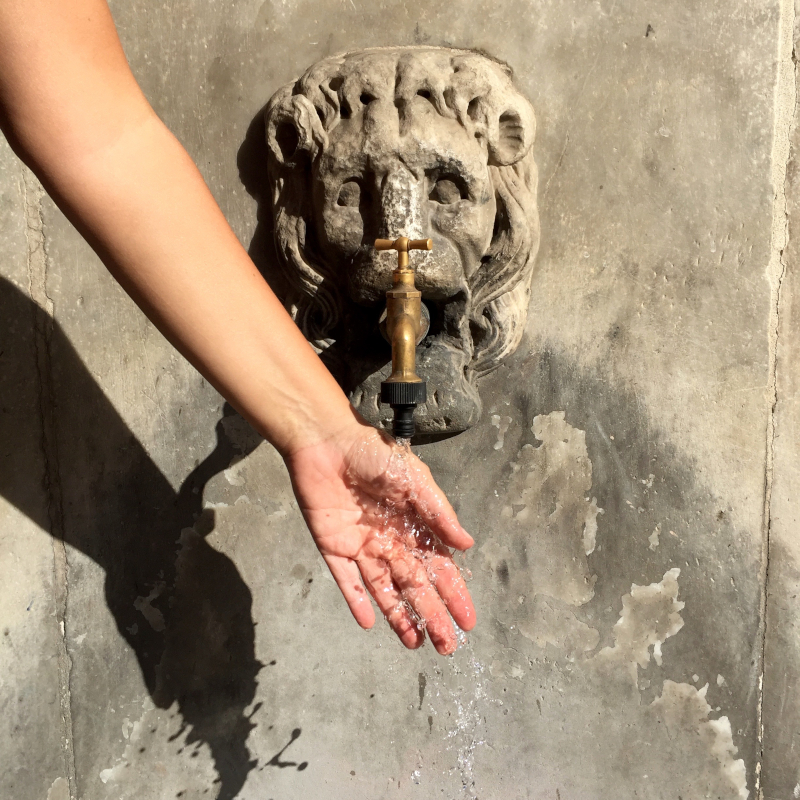
Known since the 15th century as Piazza del Grano, this historic market square hosts a fountain dating to 1715. Made of white marble, it bears the coats of arms of the Medici, the Pisan Republic, the Opera del Duomo, and the Caetani family.
Fontana di Piazza dei Cavalieri – Fontana del Gobbo (M)
Erected in 1596 by Pietro Francavilla after a design by Giambologna, this fountain stands at the base of the statue of Cosimo I. The curved figure giving the fountain its name faces a shell-shaped basin supported by a marine monster, celebrating the completion of Pisa’s Medici aqueduct.
Fontana del Giardino dei Semplici
From Piazza dei Cavalieri, the water conduit continued toward what is now the Botanical Garden, Europe’s oldest, founded in 1543 by Cosimo I to support the University of Pisa. The garden reached its final location under Ferdinando I near Via Santa Maria.
Texts by: F. Origlia and M. Colombini – Piedi in Cammino APS
Bibliographic sources:
Chiare, fresche et dolci acque… (Pisa, 2007)
Il Principe, la città, l’acqua. L’Acquedotto Mediceo di Pisa (Pisa, ETS, 2015)


